Boards That Remember: Conserving Historic Wall Panelling in Old Wessex Houses
Photo: Evelyn Simak , CC BY-SA 2.0, via Wikimedia Commons
Wall panelling is often treated as a decorative surface, yet in many old Wessex houses it is among the most eloquent fabric in the building. A dado run in a Hampshire farmhouse, a linenfold fragment in a Dorset hall or a fielded scheme in a Wiltshire townhouse can preserve the tool marks, fixing sequences and alterations of several centuries. The task is not to make it new, but to read it clearly, stabilise it gently and leave its evidence intact.
Begin with the whole scheme
Before any repair is ordered, the panelling should be recorded as a composition rather than a set of separate boards. Photograph each elevation in raking light, measure the panel widths and note the relationship between rails, stiles, cornice, skirting and adjoining joinery. Differences in timber, moulding profile or fixing method may indicate later insertion, reuse or repair. A panel that appears out of alignment is not necessarily defective; it may be an original board that has shrunk within a traditionally framed scheme.
Look also for ghost marks on the wall behind loose sections. These can reveal earlier openings, removed chimney breasts or a previous layout of the room. Such evidence is easily lost when panelling is taken down and reassembled without a record. Where sections must be removed for access, label them on the reverse in a reversible manner and store them flat in a dry, stable place.
Reading the evidence in the boards
Historic panelling in Wessex ranges from simple flat boards and dado rails to raised and fielded panels, scratch mouldings and linenfold work. Oak is common, but pine and other softwoods appear in later schemes and in painted rooms. Hand-sawn marks, mortise-and-tenon joints, wrought nails and varied paint layers all contribute to the history of the joinery. Where the reverse is accessible, examine the back for saw marks, redundant fixings and earlier surfaces; these are often more informative than the face.
Paint should not be stripped in pursuit of a supposed original appearance. Layers of paint and distemper are part of the building's history, and stripping can damage tooled surfaces and loose early coatings. If analysis is needed, a small cross-section sample taken by a conservator can identify successive schemes without destroying the visible finish. The same caution applies to sanding: a lightly cleaned surface is preferable to a flattened one.
Common failures and their causes
Loose panels usually reflect movement rather than simple old age. Timber shrinks and swells with changes in relative humidity, and fixings can lose purchase after decades of vibration or repeated decoration. Damp behind panelling is a particular risk in old houses, where a failed gutter, high external ground level or blocked ventilation can trap moisture against the wall. Before re-fixing boards, the source of moisture must be addressed; otherwise the repair will fail again.
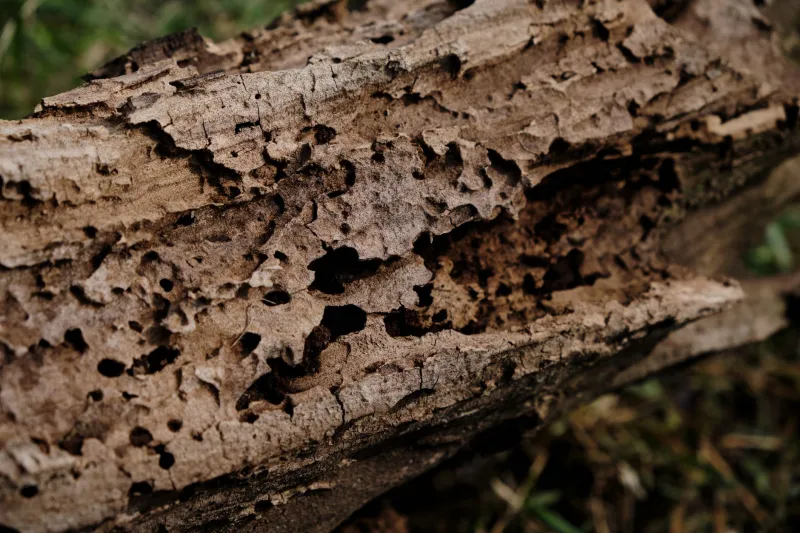
Heat damage is frequently overlooked. Radiators placed close to panelling, wood-burning stoves and flues can cause cupping, splitting and blistering paint as the timber dries unevenly. Moving the heat source or improving its shielding is usually more effective than replacing boards. Woodworm also deserves measured diagnosis. Fresh frass, clean flight holes and recent activity indicate a current problem, while old holes may be inactive. Blanket chemical treatment is rarely appropriate in a historic interior; identification and localised action are preferable.
A conservative repair sequence
The first intervention is environmental. Stabilise the room's humidity, remedy rainwater penetration and restore ventilation behind the panelling where it originally existed. Only then should loose boards be secured. Traditional cleats, battens and stainless-steel screws driven from the reverse can often re-fix a panel without visible face fixings. Where access is difficult, a reversible conservation-grade adhesive may be considered by a specialist, but modern rigid fills and foams should be avoided.
Split boards can sometimes be closed with controlled gluing and clamping, retaining the original surface rather than sanding it away. Lost mouldings should be matched by profile and fixed minimally, with the new work dated and recorded. Complete replacement of a scheme is rarely justified by a few defects. In listed buildings, alterations to panelling may require listed building consent, and even in unlisted historic houses the principle of minimum intervention remains sound.
Finishes that let the room breathe
Finishes should protect without sealing. Traditional waxes, linseed-oil preparations and breathable paints are generally more sympathetic than polyurethane varnishes and plastic-rich coatings, which can trap moisture and make future repair difficult. A test patch in an inconspicuous area will show how a finish responds to the existing surface. The aim is not uniform colour but a stable, maintainable appearance that respects earlier layers.
Cleaning should begin with dry methods: soft brushes, museum vacuums and minimal moisture. Strong detergents and abrasive pads can remove early paint and patina. Maintaining a stable indoor climate, avoiding draughts through the panelling and keeping gutters and rainwater goods in order will do more for the long-term survival of the scheme than any cosmetic treatment.
When to involve a specialist
Panelling that is structurally loose, affected by active insect attack, suffering from persistent damp or carrying significant historic paint should be assessed by a conservator or experienced heritage joiner. Wessex Restoration's approach is to record first, understand the failure and repair only what is necessary. A panelled room is not simply a wall covering; it is a record of craft, alteration and occupation. Read carefully, it can be conserved for another generation without being erased.