A Gentle Advent: Decorating a Historic Wessex Home Without Leaving a Mark
In a historic Wessex house, the arrival of Christmas can feel like a small building project. Garlands need anchoring, wreaths need hanging and candles need placing, yet the fabric beneath is often older, softer and more forgiving than it looks. Old plaster, historic wallpaper, oak beams and lime-rendered walls all respond badly to impatient fixings. The aim for the 2026 festive season should be a scheme that is generous in effect but entirely reversible in practice.
Start with the fabric, not the foliage
Before buying a single roll of ribbon, walk through the rooms you intend to decorate and note the surfaces. Lime plaster, lath-and-plaster ceilings, historic wallpaper, painted panelling, gilded frames, stone fireplaces and exposed beams each demand a different approach. Photograph the rooms as they are, so that any change can be identified later. Decide at the outset that no new holes will be made in historic plaster and that no adhesive will be applied to porous or decorated surfaces.
Listed buildings require particular care. Christmas decorations are usually considered temporary and do not normally require listed building consent, but fixings can alter historic fabric. If a decoration would involve drilling, screwing, nailing or attaching anything to a listed surface, seek advice from the local conservation officer before work begins. When in doubt, choose a freestanding or tension-based solution.
Fixings that come away cleanly
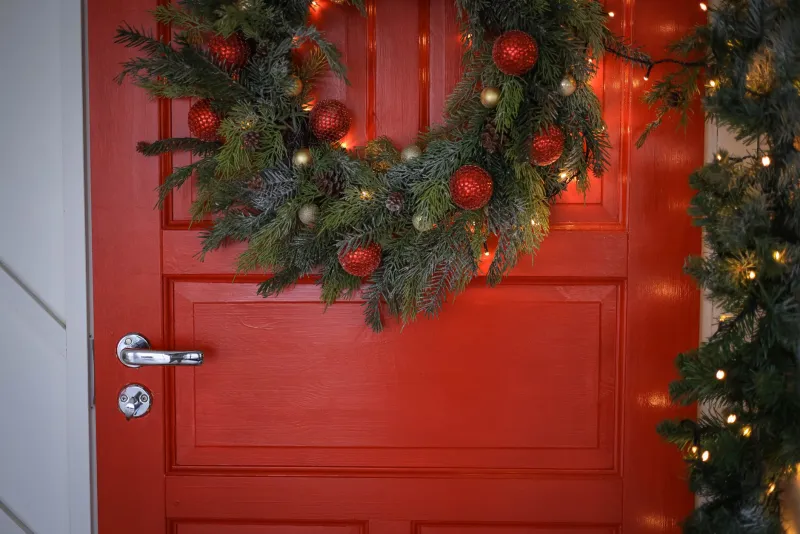
The safest fixings use what the house already provides. Picture rails, existing hooks, door frames and sound beams can often carry decorations with little more than ribbon and padding. A wreath can hang from a padded over-door hanger, provided the door is robust and the wreath is light. Garlands can be tied to beams with cotton ribbon, using a layer of soft wadding beneath the tie to prevent abrasion. Tension rods can work in window reveals, but they must not press against historic shutters, delicate mouldings or single-glazed panes.
Avoid pressure-sensitive adhesives on lime plaster, historic paint, wallpaper or gilding. Even products described as removable can pull away friable paint or leave a residue that attracts dust. Museum putty and similar materials are best reserved for stable, non-porous surfaces and should never be used as a substitute for proper support. If a fixing needs more than a ribbon, a padded hook or a freestanding stand, it is probably too ambitious for the room.
Weight, load and the limits of old structure
Plaster ceilings and cornices are not load-bearing. A ceiling rose is a decorative feature, not an anchor for a chandelier or a garland. Beams are stronger, but their surfaces can be friable and their presence does not justify a single heavy point load. Distribute the weight of garlands across several ties and keep heavy wreaths off delicate doors, which may have strained hinges or historic ironwork.
Wet greenery becomes surprisingly heavy. A soaked wreath on an old front door can pull at hinges and scrollwork, while a dense garland can drag on a beam fixing. Choose lightweight foliage, natural twine and modest scale. If an ornament would require a ladder and a helper to install, consider whether it belongs in a historic interior at all.
Candles, lights and the quiet risks
Battery-operated LED lights are the sensible default in old houses. Mains cables should not be pinned to historic skirting, run under rugs or stretched across escape routes. Use an RCD, avoid overloading sockets and keep transformers away from textiles. Candles should be flameless wherever possible. A real flame near dry greenery, linen, curtains or old timber is an unnecessary risk, and hot wax can mark stone, oak and polished surfaces.
Spray snow, glitter and scented aerosols should be avoided on porous materials. Their residues are difficult to remove and can stain lime plaster, brick and textiles. Keep decorations away from damp walls and never wrap beams tightly in plastic or fabric; such coverings can trap moisture and conceal early signs of trouble.
A room-by-room checklist for 2026
- Hall and front door: use a padded over-door hanger, a lightweight wreath and a non-slip mat. Do not nail into an historic door.
- Drawing room: dress the mantel with freestanding greenery or removable clips on a modern insert, not tape on stone or marble.
- Staircase: tie garlands to the handrail with cotton ribbon, keep balusters free of load and preserve a clear handhold.
- Dining room: use a table centrepiece and battery candles; keep foliage away from linen and place settings.
- Kitchen: keep decorations away from heat sources, sharp edges and extraction equipment.
- Bedrooms: prefer battery tea lights and avoid trailing cables near historic furniture.
- Exterior: fix only to modern, sound elements and check listed-building advice before attaching anything to old doors, stone or render.
Undressing with care
Take decorations down in dry weather and inspect the surfaces afterwards. Look for paint lifting, new cracks, damp patches or loose mortar. Store greenery and ribbons dry, and note any fixings that need attention before next year. A heritage-safe Christmas is not about minimal decoration; it is about ensuring that the house is unchanged when the last garland comes down.